NEP Implementation

St. Xavier’s College (Autonomous), Ahmedabad has introduced National Education Policy-2020 from the academic year 2023-24. By integrating humanities and arts with STEM, college envisages to foster creativity, innovation, and critical thinking and various ethos of NEP-2020 in the curriculum. This interdisciplinary model makes learning more engaging and enjoyable, preparing students for complex global challenges with well-rounded, higher-order cognitive skills.

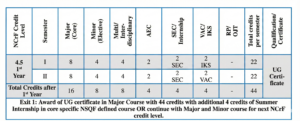
As per NEP, the undergraduate degree will be of either 3 or 4-year duration, with multiple exit options within this period, with appropriate certifications, e.g., a UG certificate after completing 1 year in a discipline or field including vocational and professional areas, or a UG diploma after 2 years of study, or a Bachelor’s degree after a 3-year programme. The 4-year multidisciplinary Bachelor’s honours programme, however, shall be the preferred option since it allows the opportunity to experience the full range of holistic and multidisciplinary education in addition to a focus on the chosen major and minors as per the choices of the student.

NEP highlights certain fundamental principles that would guide both the education system at large, as well as individual educational institutions. The principles that have a direct bearing on the curricula for different levels of higher education include:

  • Recognizing, identifying, and fostering the unique capabilities of each student to promote her/his holistic development.
  • Flexibility, so that learners can select their learning trajectories and programmes, and thereby choose their own paths in life according to their talents and interests.
  • Multidisciplinary and holistic education across the sciences, social sciences, arts, humanities, and sports for a multidisciplinary world.
  • Emphasis on conceptual understanding rather than rote learning, critical thinking to encourage logical decision-making and innovation; ethics and human & constitutional values, and life skills such as communication, teamwork, leadership, and resilience.
  • Extensive use of technology in teaching and learning, removing language barriers, increasing access for Divyang students, and educational planning and management.
  • Respect for diversity and respect for the local context in all curricula, pedagogy, and policy.
  • Equity and inclusion as the cornerstone of all educational decisions to ensure that all students are able to thrive in the education system and the institutional environment are responsive to differences to ensure that high-quality education is available for all.
  • Rootedness and pride in India, and its rich, diverse, ancient, and modern culture, languages, knowledge systems, and traditions.
  • Credit Distribution Framework for three/four years Degree/Honours/ Honours with Research.
  • Degree Programme with Multiple Entry and Exit options.

NEP envisages several transformative initiatives in higher education. These include:
• Introducing holistic and multidisciplinary undergraduate education that would help develop all capacities of human beings – intellectual, aesthetic, social, physical, emotional, ethical, and moral – in an integrated manner; soft skills, such as complex problem solving, critical thinking, creative thinking, communication skills; and rigorous specialization in a chosen field(s) of learning.

• Adoption of flexible curricular structures in order to enable creative combinations of disciplinary areas for study in multidisciplinary contexts that would also allow flexibility in course options that would be offered to students, in addition to rigorous specialization in a subject or subjects.

• Inclusion of credit-based courses and projects in the areas of community engagement and service, environmental education, and value-based education.

• Environment education to include areas such as climate change, pollution, waste management, sanitation, conservation of biological diversity, management of biological resources and biodiversity, forest and wildlife conservation, and sustainable development and living.

• Value-based education includes the development of humanistic, ethical, Constitutional, and universal human values of truth, righteous conduct, peace, love, nonviolence, scientific temper, citizenship values, and life skills.

• Lessons in service and participation in community service programmes to be an integral part of holistic education.

• Students to be provided with opportunities for internships with local industry, businesses, artists, crafts persons, etc., as well as research internships with faculty and researchers at their own or other HEIs/research institutions, so that students may actively engage with the practical side of their learning and, as a by-product, further improve their employability.

• Reorienting teaching programmes to ensure the development of capabilities across a range of disciplines including sciences, social sciences, arts, humanities, languages, as well as vocational subjects. This would involve offering programmes /courses of study relating to Languages, Literature, Music, Philosophy, Art, Dance, Theatre, Statistics, Pure and Applied Sciences, Sports, etc., and other such subjects needed for a multidisciplinary and stimulating

learning environment.

• Preparing professionals in cutting-edge areas that are fast gaining prominence that will be

woven into undergraduate education for enhancing the employability of the youth.

Courses from the discipline or subject of main focus and the degree will be awarded in that
discipline. Students should secure the prescribed number of credits (a minimum of 50% of
total credits) through core courses in the major discipline. (For eg: It can be either Physics /
Biotechnology / Statistics / Mathematics / Biochemistry etc.)

These courses help a student to gain a broader understanding beyond the major discipline. Students
need to secure a minimum of 30 credits via the minor stream courses.

Courses in which students are asked to understand the core subject as it is seen by two or more
traditional disciplines. For example, a Physics major with a minor in Mathematics can choose
either Electronics or Chemistry as the multidisciplinary course. With exposure to basic courses in
an additional discipline, a student can decide to continue the chosen major or change the major
and minor areas of interest at the end of the second semester.

A course from the discipline which are outside their chosen stream of study. These courses are
intended to broaden the intellectual experience and form part of liberal arts, commerce and
science education. For example, a student pursuing his graduation in science stream would choose
interdisciplinary courses offered by the College in the streams of arts/commerce/computer science
and similarly student pursuing his graduation in arts/commerce/computer application will choose
one interdisciplinary courses from the courses offered by the science stream.

These aim at enabling the students to acquire and demonstrate the English language skills
which will include critical reading and expository and academic writing skills that help students
articulate their arguments and present their thinking clearly and coherently and recognize the
importance of language as a mediator of knowledge and identity. The courses will also emphasize
the development and enhancement of skills such as communication, and the ability to participate/
conduct discussion and debate.